
Coin Grading Basics: What MS-63, VF-20 and 'Details' Mean
How the 1–70 Sheldon scale works, what the letters and plus signs on a slab mean, when third-party grading is worth paying for, and how to record grades.
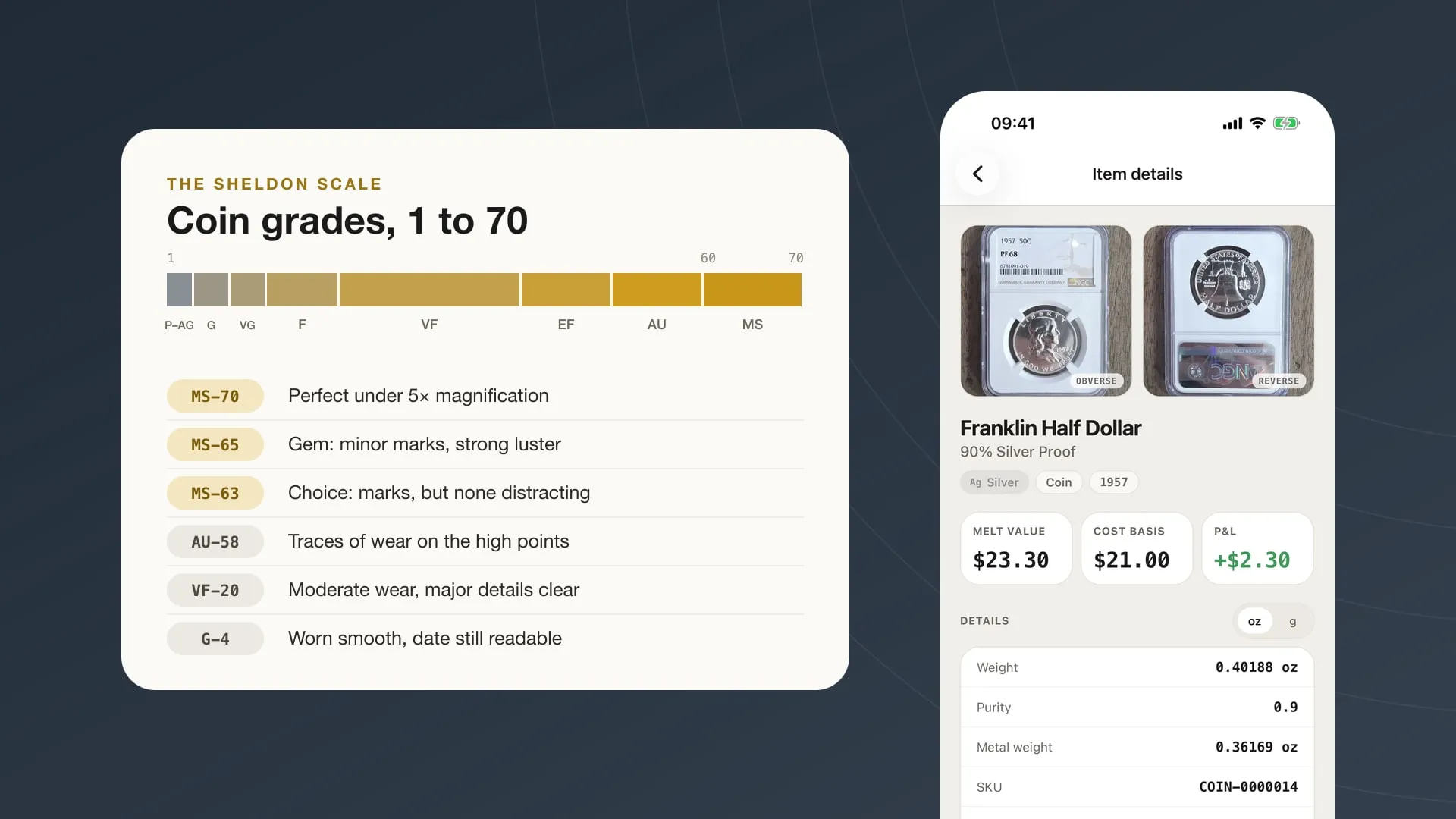
Two coins with the same date and mint mark can sell for $40 and $4,000. Usually the difference is the grade: one short code that sums up how much wear a coin has, how well it was struck and how good it looks. If you collect anything beyond bullion, grades decide a large share of what your coins are worth, so it pays to know how to read them.
The 1–70 Sheldon scale
US coins are graded on the Sheldon scale, which runs from 1 to 70. Dr. William Sheldon came up with it in 1949 for early large cents, and the major grading services later adopted it for coins of every kind. Each grade has a number and an abbreviation, and the abbreviation tells you which band the coin is in:
| Grade | Name | What it looks like |
|---|---|---|
| P-1, FR-2, AG-3 | Poor, Fair, About Good | Heavily worn. The coin can be identified, but parts of the date or legend may be gone. |
| G-4, G-6 | Good | Worn smooth with little detail left, but the date and lettering are readable. |
| VG-8, VG-10 | Very Good | Main design outlined, with some interior detail starting to show. |
| F-12, F-15 | Fine | Even wear, with major design elements clear and bold. |
| VF-20 to VF-35 | Very Fine | Moderate wear on the high points, and most finer details still visible. |
| EF-40, EF-45 | Extremely Fine | Light wear on the highest points only. (Also written XF.) |
| AU-50 to AU-58 | About Uncirculated | Traces of wear on the high points, with much of the original luster left. |
| MS-60 to MS-70 | Mint State | No wear at all. The number reflects marks, luster, strike and eye appeal. |
“Good” is one of the lowest grades on the scale. The names come from an era when any coin you could still read counted as good. Read the number, not the adjective.
The step that matters most is from AU-58 to MS-60. Below it, a coin has circulated. Above it, it never has. An AU-58 can look better than a low Mint State coin, and dealers often like them for that reason, but no amount of eye appeal makes a coin with wear Mint State.
Inside Mint State: why MS-63 and MS-65 are priced so differently
Within the Mint State range, grades are about contact marks (the nicks coins pick up rubbing against each other in mint bags), luster, strike and overall eye appeal:
- MS-60 to MS-62: uncirculated, but with plenty of marks, dull luster or a weak strike.
- MS-63 (“Choice”): some marks, but nothing that distracts.
- MS-65 (“Gem”): only minor marks, with strong luster and good eye appeal.
- MS-67 and up: superb coins with marks you’ll struggle to find without magnification.
- MS-70: perfect, with no flaws visible under 5× magnification.
Price doesn’t rise smoothly through those grades. For many older series it jumps at a few points, especially at MS-65, where a coin can be worth several times what the same coin brings at MS-64. Before you pay a high-grade price, check what the next grade down sells for. Whether the coin is a key date matters as well: the coin catalog ranks each series’ scarce years by mintage.
Modern bullion and commemoratives work the other way. Most survive in high grades, so MS-69 is common and the premium is mostly for MS-70, which is the grade people buy them for.
Proofs are graded on the same scale
Proof coins are struck with polished dies on specially prepared blanks for collectors, not for circulation. They use the same 1–70 numbers with a PR or PF prefix, so PF-68 means a proof graded 68. A proof can also be worn, and a circulated proof gets a grade like PR-45. Proof grading focuses on hairlines from handling and the contrast between frosted design and mirrored fields.
The letters and symbols after the number
Graded coins often carry extra designations on the label. The common ones:
- Plus (+): a coin at the top of its grade, nearly the next one up. Used by PCGS and NGC from about EF-45 to MS-68.
- Star (★): NGC’s mark for exceptional eye appeal, often attractive toning.
- Color, for copper: RD (red), RB (red-brown) and BN (brown). Full red copper is worth the most.
- Proof contrast: Cameo, Deep Cameo (DCAM) or Ultra Cameo (UCAM) for proofs with strongly frosted designs against mirrored fields. Prooflike (PL) and Deep Mirror Prooflike (DMPL) mean the same kind of look on business strikes such as Morgan dollars.
- Full strike designations: Full Bands (FB) on Mercury dimes, Full Bell Lines (FBL) on Franklin halves, Full Head (FH) on Standing Liberty quarters and Full Steps (FS) on Jefferson nickels. A full strike can be worth far more than the same grade without one.
- CAC sticker: a green (or gold) sticker on a PCGS or NGC holder means CAC reviewed the coin and agreed that it’s solid for its grade, or better. CAC now also grades coins in its own holders.
”Details” grades: when a coin has a problem
Some coins can’t get a straight grade because something has happened to them: they’ve been cleaned, scratched, bent, tooled, damaged by the environment, or covered in residue from old PVC flips. Rather than giving a number, the services describe the coin by how much wear it shows and name the problem. The label reads something like “AU Details – Cleaned”. NGC calls these details grades, and PCGS puts them in its “Genuine” holders.
A details coin is authenticated, so you know it’s real. It’s also worth much less than a problem-free coin at the same level of wear, often a fraction. If you’re buying, read the whole label, not just the letters that look like a grade. If you’re cataloging, record the details designation as well as the wear level, so the collection’s value isn’t overstated.
It’s also the best argument for never cleaning a coin. Polishing a dull coin can take it from a straight grade to details in a few seconds, and the damage can’t be undone.
When third-party grading is worth paying for
PCGS and NGC are the two largest grading services. ANACS, ICG and CACG also grade coins. Each authenticates the coin, grades it and seals it in a tamper-evident holder with a unique certification number. Grading isn’t cheap. Once you add submission fees, shipping and insurance both ways, and any membership, expect to pay roughly $20 to $100 or more per coin, depending on the service, the coin’s value and how fast you want it back. Check the current fee schedules before you send anything.
It’s usually worth it when:
- Value depends on the grade. One grade either side can be worth more than the fee.
- The coin is a key date or often counterfeited. Authentication is half of what you’re paying for, and buyers will ask for it.
- You plan to sell online. Buyers who can’t see the coin rely on the holder, and certified coins sell more easily.
- It’s a modern coin that might be a 70. The difference between 69 and 70 can be large.
It usually isn’t worth it for common bullion, circulated common dates or junk silver, where the coin is worth about its metal and grading would cost more than it adds.
Before you buy a certified coin, look up its certification number on the grading service’s website. PCGS and NGC both offer free lookups. The result should match the coin, date, grade and photos in front of you. It’s the quickest check for a fake holder.
Grading a raw coin yourself
You won’t match a professional grader, but you can get close enough to know whether a coin is worth sending in:
- Use a single, angled light and tilt the coin under it. Wear and hairlines show up as the light moves.
- Look at the high points first, such as the cheek, hair and eagle’s breast, depending on the design. Wear starts there.
- Use a 5× to 7× loupe. Higher magnification makes every coin look terrible.
- Compare with photos of certified coins of the same type at a few grades. Both PCGS and NGC publish them.
- Handle coins by the edges, over something soft, and never wipe or clean them.
Be conservative with your own estimate. Most collectors grade their own coins a little too high.
Recording grades so your numbers stay honest
For anything certified, record three things: the grade (including any designations), the grading service and the certification number. The cert number is what ties your record to the actual coin. It also helps with insurance claims and lets a buyer verify the coin when you sell. For raw coins, note your own estimate and mark it as raw, so you never mistake it for a certified grade later. If you also keep metal and weight, you’ll always know what a coin is worth as metal, separately from what it might bring as a collectible. Our guide to organizing a coin collection covers the rest of a good record.
In My Coin Stack, every item in your Collection has fields for the grade, the grading service (PCGS, NGC, ANACS, ICG, CAC or raw) and the certification number, along with photos of the coin and its slab label. These are included on every plan, the free one too. You can then filter the collection by grading service and grade, and a data-quality filter lists every item that’s still missing a grade.
The Analysis tab in Reports shows how much of your collection is graded versus raw, how your graded coins are split between services, and how they’re spread across grades. And when you list a graded coin on the Marketplace, the grade, service and cert number carry over as structured fields, so buyers can see them and look them up without asking.
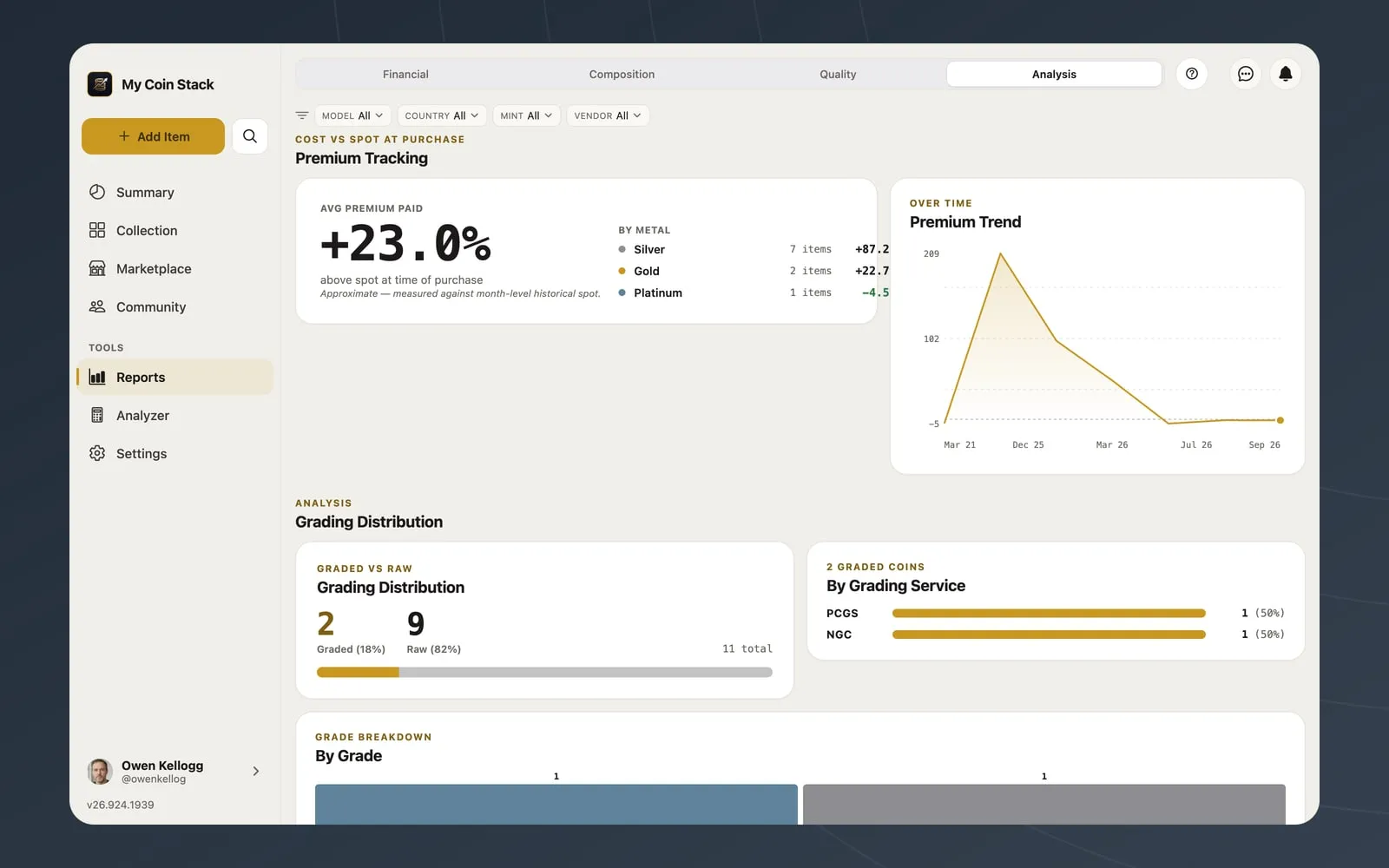
The Analysis report breaks a collection down into graded and raw coins, and the graded ones by service and grade.
Try it
Pick a few of your best coins and add their grades and cert numbers in any browser, on mobile or on your TV. Once every slab has its number on record, you’ll know exactly what you have and how each grade was decided.
This article is general information about coin grading, not financial advice. Grading standards and fees vary by service and change over time; check each service’s own guides and fee schedules.
Keep reading
Junk Silver Explained: How Much Silver Is in Pre-1965 US Coins
Pre-1965 dimes, quarters and halves are 90% silver. How much silver each holds, how to value a pile of them, and how to check a 'times face' quote.
Inside the Catalog: 60,000+ Coins From 200+ Countries
One search covers more than 60,000 coins from over 200 countries, with mintages, key dates and design notes, plus weights that fill in when you add a coin.
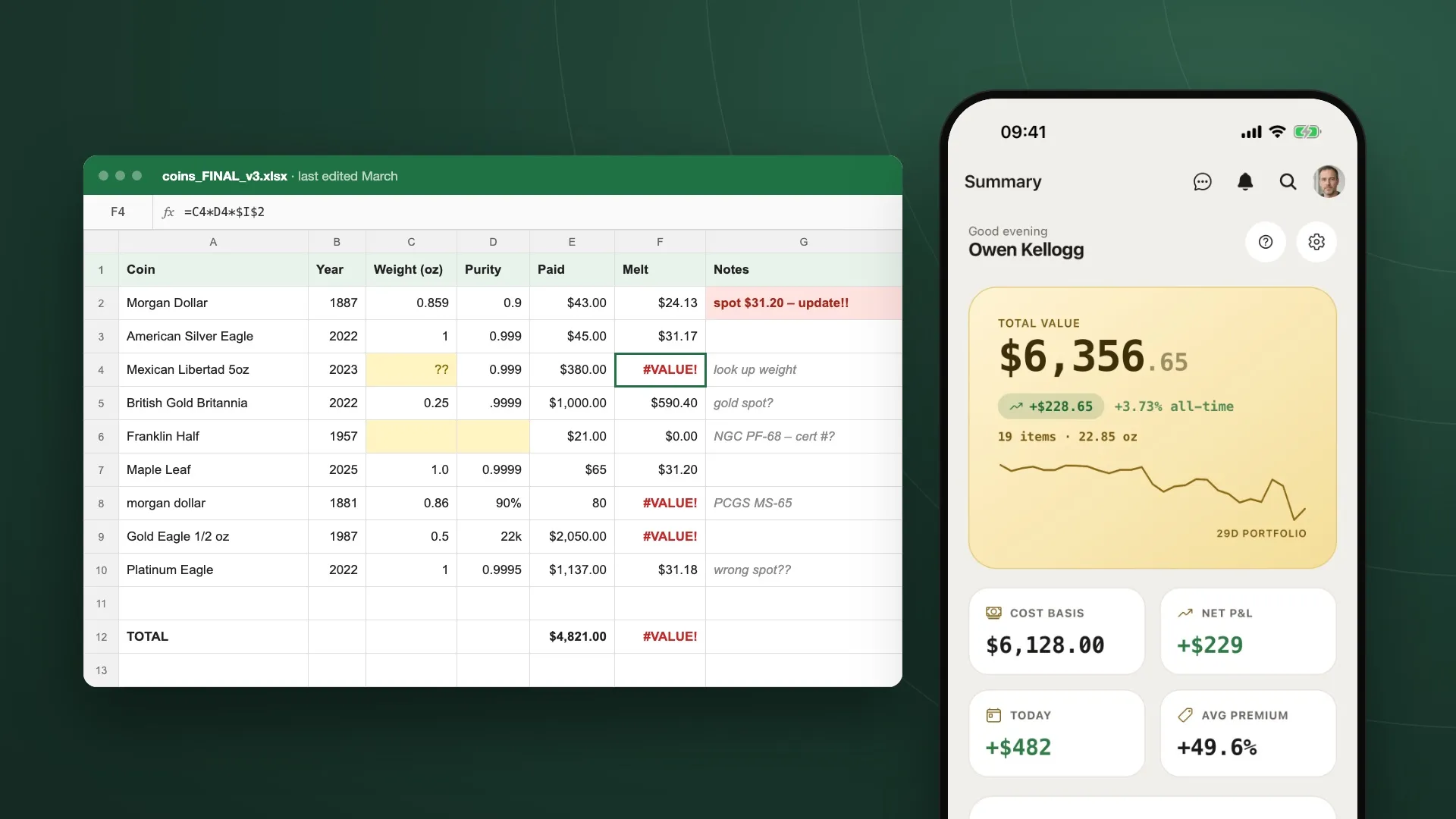
Coin Collection Spreadsheet vs. an App: What You Gain
Spreadsheets are where most collections start. Where they fall short: stale spot prices, hand-typed weights, fragile formulas, and a file stuck on one computer.

Put it to work on your own stack.
My Coin Stack is free in any browser, with no card required.