
Gold Coins vs. Gold Bars: Premiums, Liquidity and Resale
What you pay over spot for gold coins and bars at each size, how easily each one sells, and why the cheaper option to buy isn't always cheaper to own.
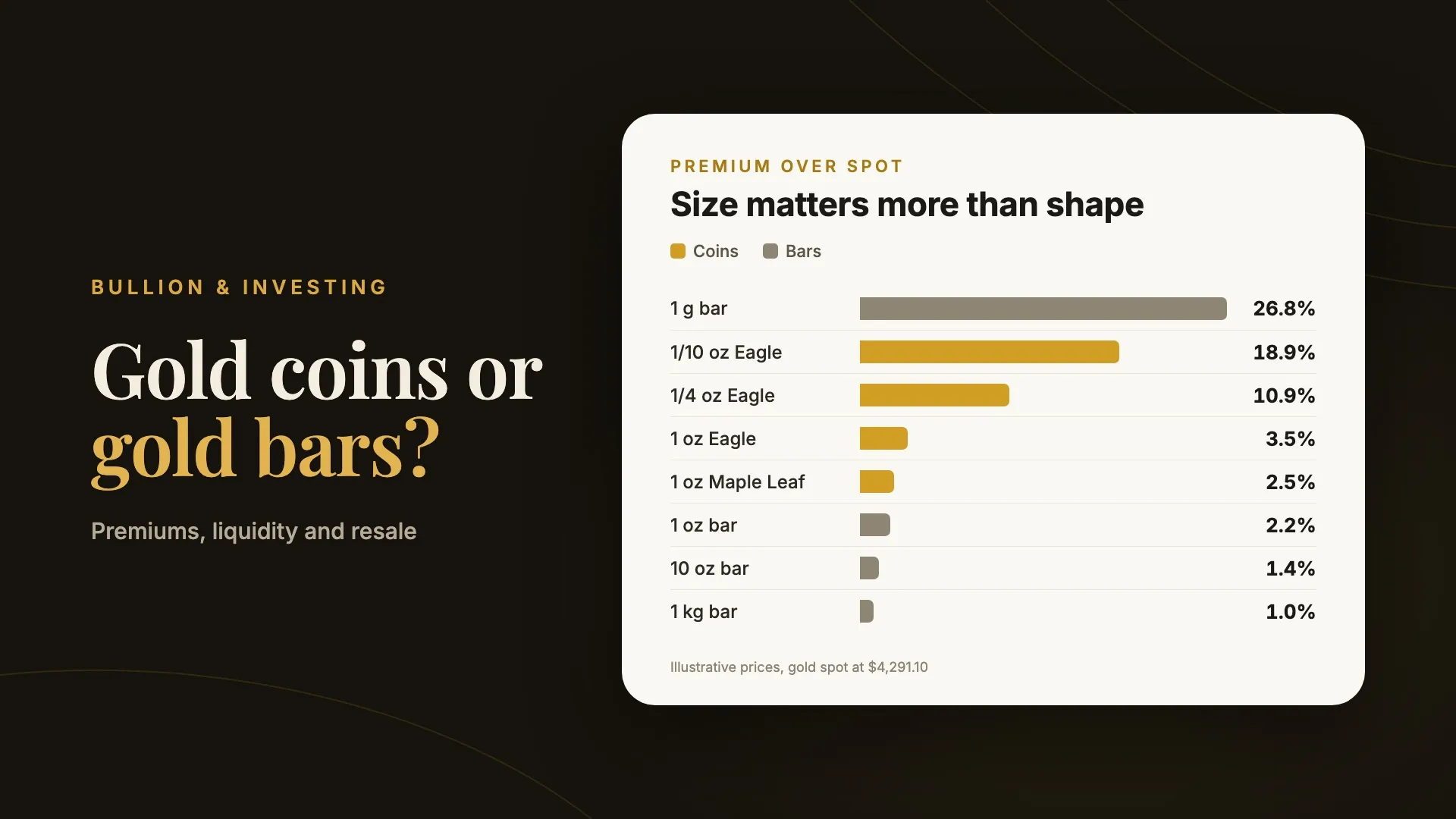
An ounce of gold is an ounce of gold, whether it’s in a coin or a bar. What changes is how much you pay over the metal to buy it, and how much of that you get back when you sell. Bars are usually cheaper to buy. Coins are usually easier to sell. Which one comes out ahead depends mostly on size.
The short answer
- At one ounce, coins and bars cost about the same. A well-known bar is typically a point or so cheaper over spot than a government coin.
- Above one ounce, bars win on price. Coins top out at one ounce for most buyers, while 10 oz and kilo bars carry the lowest premiums in gold.
- Below one ounce, both get expensive fast. Small bars and fractional coins can cost 10% to 25% or more over spot.
- Coins sell more easily, especially in small amounts and to buyers who don’t know you. That gets back some of the extra you paid.
What you pay over spot, by size
Every gold price is melt value plus a premium. If you haven’t worked one out before, our guide to calculating the premium over spot walks through the formula. Here’s how premiums tend to step down as size goes up, using illustrative prices with gold spot at $4,291.10:
| Product | Pure gold | Melt value | Price | Premium | Cost per oz |
|---|---|---|---|---|---|
| 1 gram bar | 0.032 oz | $137.96 | $175 | 26.8% | $5,443 |
| 1/10 oz Gold Eagle | 0.100 oz | $429.11 | $510 | 18.9% | $5,100 |
| 1/4 oz Gold Eagle | 0.250 oz | $1,072.78 | $1,190 | 10.9% | $4,760 |
| 1 oz Gold Eagle | 1.000 oz | $4,291.10 | $4,440 | 3.5% | $4,440 |
| 1 oz Maple Leaf | 1.000 oz | $4,291.10 | $4,400 | 2.5% | $4,400 |
| 1 oz gold bar | 1.000 oz | $4,291.10 | $4,385 | 2.2% | $4,385 |
| 10 oz gold bar | 10.000 oz | $42,911.00 | $43,500 | 1.4% | $4,350 |
| 1 kilo gold bar | 32.151 oz | $137,961.97 | $139,400 | 1.0% | $4,336 |
Real prices move with spot, with demand and from one dealer to the next, so treat these as the shape of the market rather than quotes. The shape is consistent, though: the line between coins and bars matters much less than the line between small and large.
Why small pieces cost more per ounce
Striking, packaging, shipping and handling cost roughly the same per piece whatever it weighs. Spread over a kilo, that cost almost disappears. Spread over a tenth of an ounce, it’s a large share of the price. That’s why a 1 gram bar can cost more per ounce than a 1/10 oz coin, even though bars are “supposed” to be the cheap option.
Why coins cost a little more at the same size
At one ounce, a government coin usually carries a slightly higher premium than a bar from a private refiner. Part of that is cost: coins are struck to tighter standards, with detailed designs and, increasingly, anti-counterfeiting features. Part of it is demand: people pay for recognition, and the American Gold Eagle in particular trades at a higher premium than most other one-ounce coins.
Liquidity: how easy each one is to sell
Liquidity is how quickly you can turn something into cash at a fair price. Gold is liquid in general, but not all gold equally.
Government coins are the easiest to sell. An American Gold Eagle, Canadian Maple Leaf, South African Krugerrand or British Britannia is recognized by every bullion dealer and most coin shops, in the US and abroad. The weight and purity are guaranteed by the issuing government, and a buyer can check a coin quickly against its known specifications.
Bars from well-known refiners are close behind. A 1 oz or 10 oz bar from a refiner dealers know, still in its assay card with a matching serial number, sells about as easily as a coin. Generic or unfamiliar bars sell too, but some buyers will pay less for them or want to test them first.
Large bars are all or nothing. You can sell one coin out of twenty, but you can’t sell half of a 10 oz bar. If you need $4,000 and all your gold is in kilo bars, you’ll be selling far more than you need. Buyers for large bars are also fewer, and some will test them before paying, which takes time and can cost you a fee.
Divisibility helps beyond selling. Gold in several smaller pieces is easier to give away, split between heirs, or sell bit by bit as prices change. That flexibility is one of the main arguments for holding at least some gold in one-ounce coins.
Resale: what you actually get back
When you sell common bullion to a dealer, you get their buy price, which is tied to spot. The premium you paid when you bought is mostly a cost you don’t get back. How much of it you do get back depends on the product.
Dealers often pay a little over spot for popular government coins, because they can resell them quickly at a good premium. For bars, especially generic ones, buy prices tend to sit at spot or slightly under. So the coin that cost more to buy can also bring more when you sell.
Here’s an illustrative round trip for one ounce, buying at the prices in the table above:
| Paid | Dealer buys back at | Round-trip cost | |
|---|---|---|---|
| 1 oz American Gold Eagle | $4,440.00 | $4,331.10 (spot + $40) | $108.90 |
| 1 oz gold bar | $4,385.00 | $4,281.10 (spot − $10) | $103.90 |
The bar was $55 cheaper to buy, but on these numbers it’s only $5 cheaper once you’ve sold it. The real buy prices in your area might shrink that gap further or widen it, so it’s worth checking a dealer’s buy prices, not just their sell prices, before deciding.
The round-trip cost is the number that matters if you plan to sell one day. At larger sizes, bars win easily on that measure too, because their premiums are so low to begin with.
Counterfeits and authenticity
Both coins and bars are counterfeited, and the fakes are getting better. A few things tip the balance toward coins for many buyers:
- Known specifications. Every government coin has a published weight, diameter and thickness, so a precise scale and calipers will catch most fakes.
- Security features. Several mints now build anti-counterfeiting features into their coins. The Royal Canadian Mint micro-engraves a tiny maple leaf on the Maple Leaf, and the Royal Mint has added a latent image to the Britannia that changes as you tilt it.
- Easier to check small amounts. A fake one-ounce coin costs you one ounce. A tungsten-cored kilo bar costs you a kilo.
Bars sold in sealed assay cards with serial numbers are much harder to fake convincingly, and buying from an established dealer matters more than which form you choose. Either way, keep the original packaging: a bar out of its assay card, or a coin out of its mint tube, can be harder to sell at full price.
Storage
Bars are more compact. They stack neatly and fit more value into a small safe or a bank box. Coins take a little more room but come in standard tubes and monster boxes, which are easy to count and easy to sell from. If you store with a depository rather than at home, the difference hardly matters.
Whichever you hold, handle gold as little as possible. Pure gold is soft, and while a scratch won’t change the melt value, it can lower what a buyer will pay for a coin.
So which should you buy?
There isn’t one right answer, but a few patterns hold:
- Buying one ounce at a time: the gap is small. Many people choose coins for easier resale, while others take the lower premium on bars from a refiner they know.
- Buying in larger amounts: 10 oz and kilo bars have the lowest premiums, and some buyers hold a mix so they still have smaller pieces to sell.
- Buying small: fractional coins and gram bars cost a lot more per ounce. That can be worth it for gifts or for buying a little at a time, but it adds up quickly as a way to stack.
- Planning to sell soon: compare round-trip costs, not just purchase prices.
In the US, coins and bars are generally taxed the same way when you sell, so tax rarely decides between them. Check with a tax professional for your own situation.
Comparing coins and bars in My Coin Stack
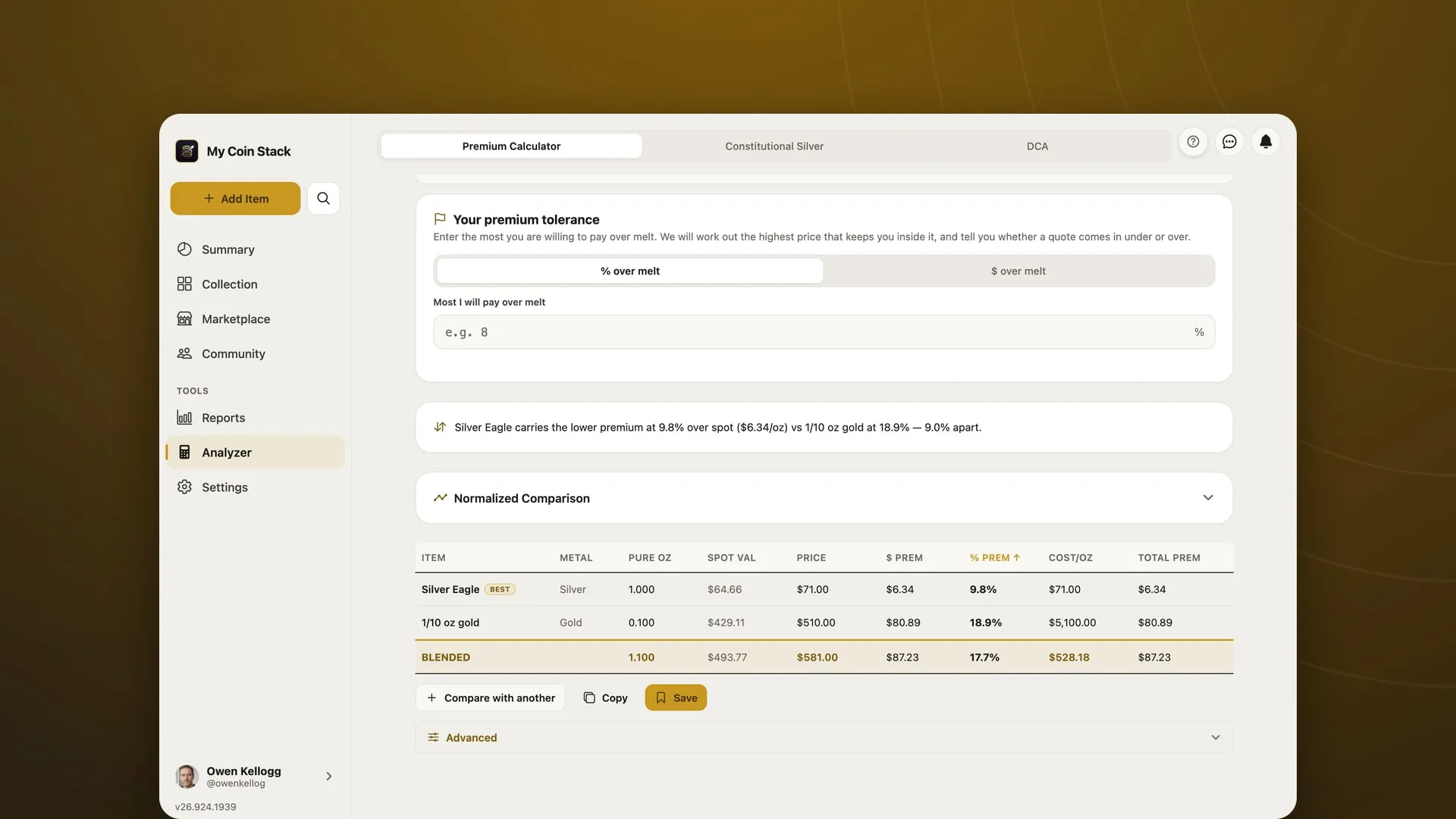
The Buy Analyzer puts a coin and a bar side by side at live spot. Enter each offer’s weight, purity and asking price, and it shows melt value, premium in dollars and percent, and cost per pure ounce, then names the better deal in plain language. Because it works per pure ounce, a 22-karat Gold Eagle and a .9999 bar compare fairly.
The comparison table can normalize every option to 1, 10 or 100 ounces, so a 1/10 oz coin and a kilo bar sit on the same scale. Budget mode answers the practical question: how much gold does $5,000 buy in each form? Once you’ve bought, add the piece to your Collection with what you paid, and its melt value follows the live spot price from then on.
This article is general information about how gold is priced and sold, not financial or tax advice.
Keep reading
How to Calculate the Premium Over Spot Before You Buy Bullion
The price on a coin is metal plus premium. Here's how to work out each part, compare offers of different sizes fairly, and decide what you're willing to pay.

How to Show Live Spot Prices on a TV in Your Coin Shop
Put live gold, silver, platinum and palladium prices on your shop's TV with a free app for Apple TV, Fire TV and Google TV. No computer and no extra cables.
Coin Grading Basics: What MS-63, VF-20 and 'Details' Mean
How the 1–70 Sheldon scale works, what the letters and plus signs on a slab mean, when third-party grading is worth paying for, and how to record grades.

Put it to work on your own stack.
My Coin Stack is free in any browser, with no card required.